
PART ONE
I Came Here in 1946
“OK… you know who I am, don’t you?”
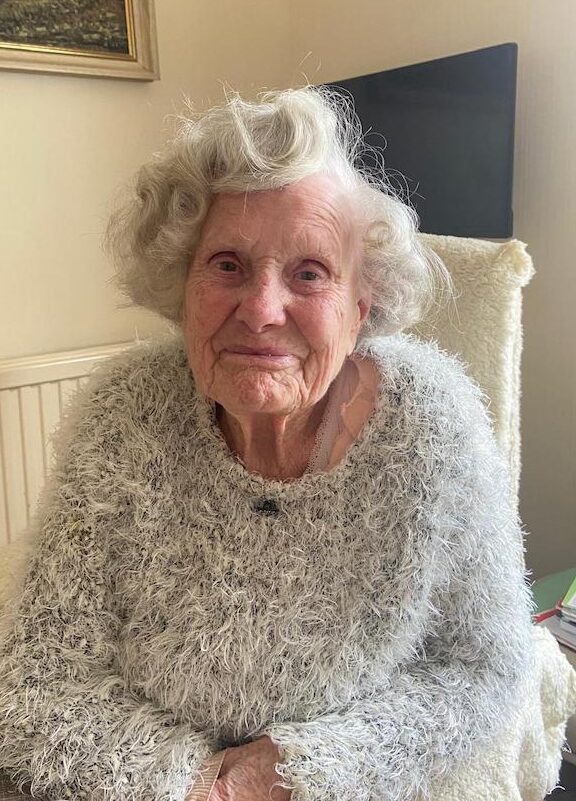
Betty says it with a playful glint, her eyes bright with mischief. A smile curls at the corner of her mouth, and then comes the soft ripple of laughter — the kind that belongs to someone entirely comfortable in her own story.
“You know my name, don’t you? Yes… good.”
She is teasing, of course. But there’s truth tucked inside the joke. After eighty years at St Mary’s, Betty is more than a familiar face. She is woven into the fabric of the place — one of those steady presences that feel as though they have always been there.
“I came to be here in 1946… just at the end of the war.”
She says it lightly, almost casually, as though moving towns in the shadow of such enormous history were the simplest of things. Yet 1946 was no ordinary year. The country was still catching its breath, balanced between relief and weariness, between what had been lost and what might yet be rebuilt.
Betty didn’t arrive with ceremony or grand intention.
“We moved into the little house by the church.”
That was all.
And there, just across from her new daily life, stood St Mary’s Church.
Not imposing. Not dramatic.
Simply present.
Steady as stone. Patient as time.
“That’s how I came to sit there in the church.”
After the War
When Betty drifts back into memory, she begins at the turning at the top of the road, where the long bridge is and now a mini roundabout.
“There was a pub there once,” she says, almost as an aside.
Not a bustling place, not rowdy or loud — just part of the everyday backdrop of those years, as ordinary and unremarkable as the pavement beneath people’s feet.
And close by, in the first small house, lived an elderly couple.
“Mr and Mrs Gayton.”
Mr Gayton, Betty recalls, was already old when she knew him. A working man through and through — the sort whose life seemed etched into his hands.
“He used to dig at the rectory…”
She pauses slightly, searching for the thread of the memory, then continues.
“…and he’d pop round the town.”
Her voice softens now, touched by affection.
“Giving you potatoes… giving you greens… pears and plums from the trees.”
The rectory garden, she explains, was enormous in those days. It stretched far beyond its present boundaries, reaching into what would one day become the car park — though no one imagined such things then.
“If he gave you a couple of pounds of pears, you gave him a shilling.”
She is clear about this part.
It wasn’t charity. It was a community.
A quiet understanding between neighbours. A gentle exchange that allowed generosity without embarrassment, kindness without obligation.
A rhythm of give and take that kept dignity intact.
“And of course his pension was very limited then… because all he ever did was old work.”
There is no sadness in Betty’s voice as she says it — only the steady acknowledgement of how life simply was.
The Ones Who Opened the Doors
A little further down the road stood another house in the terrace, and with it another couple, Betty remembers with unmistakable fondness.
“Mr and Mrs Kibble.”
You can hear the affection before she even says much more.
“They used to open the church every morning… sweep it all round… keep it very tidy.”
In Betty’s memory, these aren’t described as chores or duties. They feel closer to acts of quiet devotion — the sort of care given not because anyone asked, but because it simply mattered.
“They opened up, they locked up… they kept an eye on it.”
The church, she recalls, was never left to itself. Even on days without services, someone was there. Someone noticed. Someone tended.
Not abandoned. Not forgotten.
“He opened it every morning… locked it up again, but left it open…”
She smiles faintly at the recollection.
“…and if people went visiting, he opened the door.”
Betty pauses, her expression thoughtful, her voice carrying a gentle note of reflection.
“It’s a pity we can’t do that so much now.”
Time has changed things, of course: locks, security, different rhythms of life. But what Betty seems to miss most is not the practicality — it is the atmosphere of it all.
The feeling of a church that breathed with the daily life of the community.
“What a difference… of community church,” she says softly.
Then, with quiet wonder: “It’s amazing, really.”
A Window on Life
The house Betty and her husband moved into was, by her own cheerful admission, “not ideal.”
But, as she quickly adds with a laugh:
“Stairs and stairs again!”
If nothing else, she says, it kept them fit.
Yet what the house lacked in convenience, it offered in something far more memorable — a view that quietly wove itself into the story of her life.
“I could see all the weddings and all the funerals.”
From that window at the top, Betty watched the steady procession of human moments passing through the doors of St Mary’s.
Brides in white, floating lightly, laughter trailing behind them.
Mourners in dark coats, moving more slowly, heads bowed.
Flowers carried in trembling hands.
Bells ringing out across the rooftops.
Silence.
Music.
Joy and sorrow follow the very same path, sometimes only days apart.
Betty shakes her head gently, as though still amazed by the privilege of that vantage point.
“A whole town’s heartbeat.”
And then, softly, with that familiar note of gratitude:
“And it was lovely, really.”
PART TWO
Before Bideford
Although Betty’s life would become inseparable from Bideford, her story began elsewhere — in landscapes shaped by trees, coal, and change.
“I was born in the Forest of Dean.”
She says it with a quiet certainty, as though naming not just a place, but a beginning stitched into her bones.
Then, when she was still young:
“We moved to a place called Caerphilly in Wales.”
The move carried her into a world that felt both near and strangely unfamiliar. Her parents were English, she explains — finding their own footing in life — yet the town around them spoke a different music.
“Most of the children spoke Welsh.”
School became an early lesson in what it means to feel slightly out of step. Different sounds filled the classroom. Different rhythms coloured the playground. Words she didn’t yet understand floated past like birds she could hear but not name.
“It was different,” she says simply.
Not unkind. Not harsh.
Just different.
And sometimes, different is enough to make a child feel the delicate ache of not quite belonging.
Strange Little Connections
Years later, long after Wales had become memory rather than daily reality, Betty found herself standing outside St Mary’s after a service, chatting as parishioners do.
“Have you heard of Dermot Davis? He was Reverend here.”
When she mentioned her time in Caerphilly, his reply startled her.
“That was my first place where I trained.”
Even now, the recollection delights her — that curious, almost magical way life circles back on itself.
“It was amazing, really.” A reminder that the threads of our lives are often woven long before we can see the pattern.
A Mother’s Health
Then came one of the great turning points of Betty’s childhood.
“Mum was very unwell.” The words are spoken gently, but they carry the heaviness of uncertainty — the quiet fear that settles into a household when illness arrives and refuses to leave.
Doctors, in those days, often spoke with a practical confidence that blended medicine with instinct.
“If you go where you were born, you’ll be much better.”
It sounds almost like folklore now, Betty admits — yet decisions were made on such advice, because hope, however fragile, was something families clung to.
So they returned. Back to the Forest of Dean. Back to familiar ground.
Did it help?
“Oh yes, yes, yes.”
Relief enters her voice even decades later.
But recovery for one family member often meant upheaval for another.
Betty’s world shifted once more.
She found herself in new surroundings, in a new school.
New expectations.
“Initially, I had difficulty with school because I was way behind…”
There is no bitterness in her telling, only the matter-of-fact honesty that defines her memories.
And then, with the steady resilience that seems to echo through her entire life:
“Anyhow… I battled on.”
I Wanted to Be a Nurse
Betty says it lightly, almost dismissively, as though falling behind were a small inconvenience rather than the heavy, daily weight it can feel to a young girl trying to find her place.
At sixteen, the world can already feel decided for you.
Who is clever? Who is promising? Who will “do well.”
Her brother, she remembers, “wasn’t too bad.” He attended Grammar school. He was clever and lucky.
Betty never says this with envy. Comparison was never her nature. But for a girl who felt constantly a step behind, the difference would not have gone unnoticed.
Lessons that moved too quickly. Expectations that felt just out of reach.
And yet:
“Anyhow… I battled on.”
Not triumphantly.
Not dramatically.
Just steadily.
A Small Flame of an Idea
Somewhere in those uncertain teenage years — between classrooms where confidence didn’t come easily and a future that seemed largely mapped by other people — a thought quietly took root.
“I thought to myself… I’d like to do something.”
For a sixteen-year-old girl in those days, this was no small thing. Choices for young women were often narrow, practical, and quietly prescribed.
But Betty’s dream wasn’t about status or escape.
“I’d like to go be a nurse.”
It began as a simple wish, but beneath it lay something far more powerful: the longing to be useful, to care for others, to step into a role that held purpose and dignity.
To matter. To be needed. To do work that was undeniably real.
For a girl who had spent years feeling “behind,” nursing offered something different — a place where kindness, patience, and steadiness were strengths, not shortcomings.
“Don’t Be Silly.”
Her mother’s response came quickly.
“Don’t be silly, you can’t be a nurse.”
It was not harshness. Not truly. It was the voice of a generation shaped by caution and constraint — mothers who had lived through hardship, who feared disappointment more than limitation.
But to a sixteen-year-old girl, those words could easily have closed a door.
Could have.
Except Betty had already begun, quietly and without fanfare, to believe otherwise.
She did not argue. She did not rebel.
But somewhere inside her, the small flame of that idea did not go out.
Pocket Money and Determination
“There was a lovely children’s hospital at Gloucester.”
Betty says it with a softness that suggests more than memory — something closer to gratitude.
For a sixteen-year-old girl still finding her confidence, Gloucester might as well have been another country.
Twelve miles. Far enough to feel distant, but close enough to feel like a dream she might dare to reach.
“I saved my pocket money.” She says it simply, but there is resolve beneath the words.
In those days, pocket money was not spare change rattling at the bottom of a handbag. It was counted carefully, stretched thoughtfully, guarded with purpose. Every coin represented patience—every shilling, intention.
For Betty, those coins became something more than money.
They became hope.
Work and Responsibility
And Betty did not rely on saving alone.
“I worked in the gas office.”
She smiles at the recollection, amused by how ordinary it sounds now.
There was no glamour in it. No romance.
But it was work. It was a responsibility. It was hers.
“In those days, people had meters to put the light on.”
Prepaid meters lined the walls — small, unforgiving machines that required exactness.
“It was a shilling, and I had to be very careful… put the shilling in properly.”
One mistake meant darkness. One slip invited scrutiny.
The mechanism would click, sharp and final, and almost immediately the manager’s voice would ring out across the room:
“Have you done it right!”
For a young girl, it might have been intimidating — the raised voice, the assumption of error.
But Betty, even then, was learning something vital.
“I said, ‘Yes, sir, I have done the right thing.’”
Not defiant. Not trembling. Just quietly certain.
It is a small memory, easily overlooked. Yet it reveals the slow, unseen shaping of Betty’s character.
Precision. Care. The courage to trust her own hands.
And perhaps most importantly: The refusal to shrink simply because someone expected her to.
The Sisters of Mercy
Eventually, Gloucester ceased to be a distant ambition.
It became her world.
“The Sisters of Mercy ran it.” At once, Betty’s voice changes. The years fall away, and affection fills the space between words.
“They were lovely.”
Life within the hospital walls moved to a rhythm both disciplined and deeply human — a structure that steadied young women still learning who they might become.
“They got up at about six o’clock in the morning… prayers.”
The trainees followed soon after. “We were called at quarter to seven.”
There was no lingering in bed, no drifting into the day.
Wash. Dress. Orderliness.
And then into the small prayer room prepared for them.
“We had prayers.”
Not as an obligation alone, but as anchoring — a moment of stillness before the demands of the wards.
The Work of Caring
Breakfast came and went, and then the true work began.
“You went to the children’s ward… the boys’ ward… the baby’s ward.”
Rooms filled with tiny lives and fragile needs.
Small hands reaching. Soft cries in the early hours. Endless tasks that required patience more than praise.
Yet Betty remembers not weariness. She remembers joy: purpose and belonging.
“They were truly the happiest, caring, loving people I’ve ever met.”
And for a sixteen-year-old girl who had once been told she was “behind,” that environment offered something quietly transformative:
A place where gentleness was strength. Where steadiness mattered. Where caring was not a small thing.
PART THREE
Two Years That Changed Everything
“I so enjoyed my two years there… because I was sixteen… now I was eighteen.”
Betty says it with a warmth that has never faded. Those years at Gloucester were not simply about learning a profession — they were about becoming someone new.
A girl who had once felt behind. Unsure. Quietly searching for her place.
At the hospital, she found it:
Purpose, friendship and belonging.
“I had the best friends there.”
Among them was Audrey — companion, confidante, co-dreamer — the sort of friend who turns uncertain hopes into shared plans whispered late at night.
A Future Beyond Gloucester
As training drew to a close, the inevitable question arrived.
“You have six more months to do… have you decided what you’re going to do?” The Sisters asked.
For many young women, the path would have been predictable. Stay close. Choose something safe. Something sensible.
But Betty and Audrey had begun to imagine something larger. “London.”
The word itself carried electricity.
Opportunity. Adventure. Independence.
And danger.
1941/42
Britain was at war. London was burning.
Night after night, the sky lit with fire. Buildings reduced to rubble. Streets reshaped by destruction. The Blitz was not an abstract headline — it was a daily reality.
“It wasn’t heard of… going to London then.”
Not for young girls. Not willingly. Not when bombs were still falling.
Audrey, ever hopeful, spoke with conviction. “London will love you.”
But both their parents heard no romance in the idea. They heard risk.
“Our parents won’t let us.”
Fear lived in every household then — fear carried quietly, sensibly, wrapped in caution.
You don’t send your eighteen-year-old daughters into a city under siege.
Still, the girls persisted. They found the possibility of a home in Lewisham — a foothold in the vast and uncertain capital, thanks to the Sisters of Mercy.
The Sisters were gentle but hesitant. “We could keep an eye on you in Lewisham… but we don’t think you should go to London…”
Behind the words lay concern, not prohibition. London was unpredictable. Sirens, shelters, blackouts.
Both families said no. Firmly. Understandably.
Betty smiles when she says it, but there is steel beneath the memory.
“So… we were determined.” Not reckless. Not naïve. But young enough to believe that life must still be lived, even in wartime.
Young enough to want more than safety.
And then, eventually — perhaps worn down by persistence, perhaps persuaded by the girls’ quiet resolve —
“In the end, they said, ‘Yes.’”
A pause. A smile. “So, we went.” Two eighteen-year-old girls. Suitcases. Nerves. Excitement tangled with fear.
Heading straight into wartime London.
May I Write to You?
“We were living in London with limited money… Covent Garden was a Mecca.”
Betty smiles as she says it, and suddenly the London of war and worry softens into something lit by anticipation.
In those years, an evening out was never impulsive. It was imagined long before it happened — coins saved carefully, plans whispered between shifts, excitement stretched across weeks.
“Audrey and I used to say, ‘Do you think we can go next month?’”
And always, the arithmetic of youth:
“Two shillings and sixpence.”
A small sum, perhaps — yet to two young women living modestly in a city at war, it was precious. Every coin had been earned, spared, justified.
Pleasure required patience.
The first visit did not quite sparkle.
“It was all Americans,” Betty laughs, “and the Jitterbug, which wasn’t my thing.”
It wasn’t an unpleasant evening, but simply not for them, and for a moment, Covent Garden felt like a place belonging to someone else’s story.
But Audrey, irrepressibly hopeful, waved away disappointment.
“Oh, let’s give it another go.”
So they did.
An Ordinary Beginning
It began, as so many life-altering moments do, without ceremony.
“I met this man from Bidefordian…”
Betty gestures vaguely, smiling at the understatement of it.
“We had a few dances. I thought to myself, we danced well together.”
However, there was no grand entrance. No sudden revelation.
Just music drifting through the room. The gentle awkwardness of strangers finding a shared rhythm. Conversation rising and falling between steps.
And then he asked:
“Do you work in London?”
Betty pauses at this part, the memory still tinged with the self-consciousness of a young girl navigating attention.
“I thought — oh my goodness…”
He was kind, but he was also unknown. And these were uncertain times. London was filled with uniforms, departures, and fleeting encounters.
“I might have told him a few fibs.”
Not lies, exactly. Small evasions. Gentle deflections.
The quiet protections a young woman learns almost instinctively.
Because in wartime, nothing felt guaranteed — not safety, not tomorrow, not the intentions of a man you had only just met.
The Question
At the end of the evening, as the music faded and the night drew to its natural close, he asked the question that would linger across decades.
“May I write to you?”
Betty remembers the jolt of it — not displeasure, but sudden honesty rising like a blush.
“Oh my gosh… I’ve been telling lies, hadn’t I?”
Years later, she would be reassured:
“You weren’t lying. You were protecting yourself.”
But even then, Betty felt the pull of truth.
“So I looked at him, and I said…”
A pause.
“…‘I’ve been telling you fibs.’”
His answer came without hesitation, without offence, without the slightest trace of reproach.
“That makes no difference.”
And then, gently — so gently it would stay with her all her life:
“Can I still write to you?”
Something shifted in that moment.
Surprise. Relief. A flicker of trust.
Betty’s expression softens even now when she recalls it.
“So I said… ‘Well… yes.’”
And she gave him her address.
A Meal, A Promise
They met up again before he left for the war.
“He said, ‘May I take you to a meal?’”
“Yes,” Betty said.
A simple answer. Yet beneath it lived the fragile, cautious hope of young affection unfolding in a world overshadowed by war.
And later, another question — quieter, almost tentative:
“If I don’t see you again… is it okay to write?”
Betty’s reply was steady.
“Yes.” A pause. “You can write to me.”
She could not know then what history would place between them.
Distance. War. Waiting.
She only knew that kindness had recognised kindness.
And that something, however uncertain, had begun.
War Has Its Own Plans
History, as Betty would learn again and again, has a way of rearranging even the most hopeful beginnings.
“The Rhine crossing.” The words fall quietly, yet they carry the full weight of war.
By then, Terence was no longer simply the man she had danced with in Covent Garden. He was a soldier, moving through landscapes defined by danger, uncertainty, and orders that allowed little room for personal dreams.
In the spring of 1945, Allied forces pushed into Germany. The Rhine — wide, cold, heavily defended — stood as one of the last great barriers to the war’s end. Crossing it was no small manoeuvre. It meant pontoons under fire, artillery thundering through smoke-filled skies, men advancing into territory where survival was never assured.
“It was a terrible time,” Betty reflects. Though she does not dramatise, the enormity lingers beneath the surface. “He was injured.”
Injury and Home
The injury meant more than pain. It meant removal from the front.
It meant uncertainty. It meant being sent away to recover.
Terence went home to Bideford.
Not triumphantly. Not whole. But wounded, carrying the visible and invisible marks that war so often leaves behind.
And Betty — still in London, still young, still suspended in that fragile space between affection and attachment —
Betty waited.
Letters, in wartime and after V-E Day, were lifelines.
Proof of survival.
Proof of memory.
Proof that somewhere, someone was still thinking of you.
But days passed. Then weeks.
“I thought… everyone’s got post, and I haven’t got any post.”
There is no self-pity in the way she says it now. Yet the ache is unmistakable — the quiet loneliness of a young woman watching others receive envelopes while her own hands remained empty.
In those days, silence was never neutral.
Silence meant questions.
Was he safe? Was he recovering? Had he forgotten? Had something happened?
No news could feel heavier than bad news.
The Unknowing
For a young woman in wartime London, uncertainty became a constant companion.
The sirens still wailed. The city still trembled. And somewhere far away, a man she barely knew — yet somehow deeply cared for — was injured, unseen, unreachable.
Betty does not linger long in sorrow.
She rarely does.
Instead, memory offers a glimpse of the quiet resolve that would define her life.
“Keep trying, girl.”
Not despair. Not drama.
Just the steady instinct to carry on.
The Letter
Then, unexpectedly:
“I had a letter… from Edinburgh.” Not from Terence as she hoped, but from the church.
“The vicar wrote and said, ‘I hope I’ve got the right address and I hope I’ve got the right lady… but do you know Terence Thompson?’”
Even now, Betty delights in the gentle formality of it — that careful politeness so characteristic of the time.
“I have enclosed a stamped, addressed envelope…”
And the church acted, quite literally, as a bridge between two uncertain hearts.
Through that letter, Betty learned something surprising.
When Terence had recovered, he had asked to be posted close to home.
“Plymouth would be ideal.” He had said,
It was closer, more familiar, and perhaps safer.
But war, once again, had its own design.
“It wasn’t Plymouth… it was Edinburgh.” Betty chuckles softly. “Big difference. Two ends of the world.”
Yet somehow, against all odds, it worked.
Letters travelled where people could not. Words carried what distance denied.
And in time — slowly, gently, improbably —
“Eventually… we both moved to Bideford, after marrying in The Forest of Dean.”
PART FOUR
Vicars, Seasons, and the Life of a Parish
Has the church changed?
“Much better. Much better.”
Betty does not pause to consider the question. After eighty years at St Mary’s, her answer rises with the certainty of someone who has seen fashions change, voices come and go, and generations pass through the same ancient doors.
Not worse. Not fading.
“Much better.”
She nods gently, as though the truth of it is self-evident.
“It’s a loving, friendly, caring church.”
And when Betty says “loving,” it carries weight — because she has known what it is to lean on that love.
Betty has known many vicars.
“They come, and they go,” she says with a smile.
Faces, voices, personalities — each arriving with energy, each leaving memories behind. Like seasons moving through the life of the church.
Asked if she has a favourite, she answers not with comparison, but with affection.
“Terry always loved Paul Smith.”
And, as ever, memory becomes story.
“Paul was very handy at passing things on.”
You could get a telephone call not out of nowhere, like the day she met her long-time friend.
“Betty… would you like to visit Jean Lyle? She has lost her sister.” He asked
“‘Where’s Silver Street?’”
“Ask Terry.”
Flowers gathered. Directions uncertain and off she went — a small act of kindness, one among countless gestures that quietly sustain parish life.
Betty still laughs at the memory of knocking on the door.
“‘Who are you then?’” Jean said.
“Well…” A pause. “…Reverend Smith?”
Confusion dissolving into welcome.
Because the church, Betty knows, is not merely a building or a Sunday service. It is people noticing one another.
Turning up. Carrying flowers.
The Stroke
Then her voice changes. Not dramatically, but unmistakably.
“Terry had a massive stroke.”
Even now, the words land softly but heavily — like something fragile being set down with care.
“He lost his speech… he lost one side of his body.”
In an instant, life rearranged itself.
The man she had danced with. Laughed with—shared decades with, was suddenly silent, suddenly dependent.
Hospitals always speak in practicalities. Consultants speak in assessments.
“The consultant said to me, ‘You’d better get his name down for a home.’”
They spoke of the stairs to the flat they had moved to in Northam.
“You live in a flat with stairs.”
They spoke of the medical care he would need.
“I was told I would have to manage what they call a PEG.”
They spoke of time. “You’ve been retired longer than you worked.”
Every sentence is sensible; however, every sentence is shattering.
Because reason does not soften the blow when love is involved.
“Give Me a Week.”
Betty listened.
And then, as she had done all her life, she answered quietly.
“I said, ‘Let me give it a go.’”
A pause.
“‘Give me a week.’”
Not bravado. Not defiance. Just the steady instinct of a woman who had once trained as a nurse, who had spent a lifetime caring in small, unseen ways.
Who could not yet imagine handing her husband into someone else’s keeping.
The Bed
After four weeks in the hospital, he came home with an electric bed and a plan to keep him active. She arranged the home to fit Terry and let him come into the kitchen to watch her cook. Betty had proved what charts and forms could not measure.
After a week, they came to take the bed.
“‘Why?’ I said.”
“‘He only had it for a week… because we’ve got his name down for a home.’”
And then came the words that seem to rise from somewhere deeper than decision:
“You take the bed, you take me as well.”
She was determined that she was going to care for him. They told her she couldn’t, it wasn’t possible. Betty listened politely — then ignored them completely.
“Oh, you can’t do that.”
Betty’s reply was calm. Certain.
“Right. You can’t take the bed.” and she stood firm and watched them make phone calls, and arrange plans to make it happen.
And so Terry stayed home. “For seven years, Betty cared for him — fiercely, lovingly, and with the quiet authority of a woman who had never once believed ‘you can’t’ was a final answer.”
Seven years of lifting, tending, managing, watching, adapting.
Seven years where love was no longer romance, but devotion in its purest form.
Because love, when lived long enough, becomes something stronger than sentiment.
It has been resolved.
The Long Goodbye
In those years, there were hospital journeys. Check-ups, test and make sure the PEG was in situ and clean.
Each trip was a promise of “just a couple of days”.
“I said, ‘Oh yes… he’s in good hands.’” Betty stated.
But seven years later;
“The couple of days didn’t work out.”
Betty does not embroider this part.
She does not need to.
“I sat here, and I cried, and I cried.
And then, eventually, life — stubborn as ever — knocked again.”
After nearly sixty years of marriage, the world does not simply grow quieter.
It alters shape. Rooms change. Time stretches.
“Silence becomes something you can feel.
But so does memory. So does love. So does stubborn hope.”
The Unanswerable Question
“I thought… what shall I do?”
Betty had to decide whether to stay in he flat, or go into care.
Grief is not only sadness. It is disorientation. A life partner gone, and with them the shared rhythm of ordinary days.
I feel she made the right decision to stay in the flat.
“I started going regularly to church, again, with Jean.”
She didn’t return because sorrow vanished, not because faith erased loneliness.
But because St Mary’s had always been there.
Because faith, for Betty, was never spectacle.
It was somewhere to stand when everything else felt unsteady.
The Kindness of Others
She speaks of Jean with tenderness.
“People visited us, while Terry was ill… sometimes we were a bit of a mess… But they didn’t worry.”
Then, softly: “They visited me, afterwards… taking the trouble and not worrying about the surroundings.”
There is deep gratitude here because after loss, presence becomes everything.
A knock at the door.
A conversation.
Someone remembers you are still there.
Ordinary kindness becomes extraordinary grace.
Humour Still Lives
Even now, Betty’s humour flickers through.
After eighty years in Bideford:
“Are you still a grockle?” Iasked
She laughs.
“I don’t think you ever become anything but a grockle.”
And then, warmly:
“But it’s a nice place to live.”
“I used to walk to church.” A pause. “When I was ninety, I gave it up.”
Said not with regret, but triumph! This woman, for her age, is still agile and can put me 40 years younger to shame.
“Did you ever have children?”
“No.” And then, with gentle radiance: “I have lots of Godchildren and nephews and nieces.” A life not measured by absence, but by love given differently.
Her Favourite Hymn
“What’s your favourite hymn?” I asked
Betty answers without hesitation.
“Be still.” A pause. “And that was Terry’s favourite hymn, too.”
Stillness. Memory. Love that does not end, only changes its dwelling place.